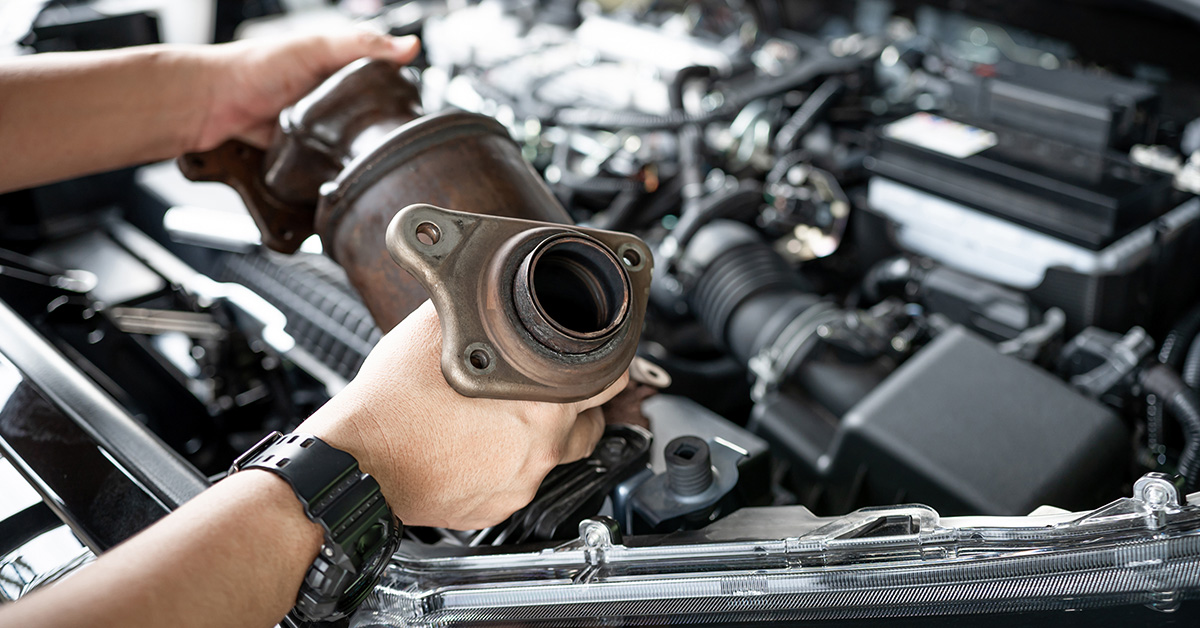
Your catalytic converter is the most valuable component on your car that you have probably never looked at. IIt quietly scrubs your exhaust of pollutants and is essential to passing your county emissions test, which is why catalytic converter repair comes up so often for Utah drivers. It also contains enough precious metal that thieves crawl under cars at night to saw it off.
When it fails, or disappears, Salt Lake City drivers feel it in three places: performance, the emissions station, and the wallet. Here is what the team at Aposhian Garage in Millcreek wants you to know.
What a Catalytic Converter Does
The converter sits in your exhaust system between the engine and the muffler. Inside its honeycomb core, precious metals like platinum, palladium, and rhodium trigger chemical reactions that convert harmful gases into far less harmful ones before they leave the tailpipe.
Along the Wasatch Front, that job matters more than most places. Our valley traps winter inversions, vehicle emissions are a major contributor, and that is exactly why Salt Lake County requires regular emissions testing. A healthy converter is your ticket through that test.
Symptoms of a Failing Catalytic Converter
Converters rarely fail without warning. Watch for these signs:
- Check engine light, often with a P0420 or P0430 code. This is the classic "catalyst efficiency below threshold" warning.
- A rotten egg smell from the exhaust. Sulfur smells mean the converter is not processing gases correctly.
- Rattling underneath the car. The internal honeycomb can break apart, and the loose pieces rattle at idle or over bumps.
- Sluggish acceleration or poor fuel economy. A clogged converter chokes the engine's exhaust flow, and the car feels like it is breathing through a straw.
- Failed emissions test. Sometimes the first symptom a driver notices is a rejection slip at the testing station.
What the P0420 Code Really Means
P0420 is one of the most common trouble codes in America, and one of the most misdiagnosed. It means the oxygen sensor readings show your catalytic converter is not cleaning exhaust efficiently. It does not automatically mean the converter is dead.
An honest diagnosis matters here, because P0420 can also be triggered by a failing oxygen sensor, an exhaust leak upstream of the sensor, or an engine running rich or misfiring and contaminating the converter. Replacing a converter is a significant expense. Replacing one when the real problem was a $200 oxygen sensor is a painful mistake, and it happens all the time when shops skip proper testing.
Just as important: whatever killed the first converter will kill the second one. If your engine is burning oil or misfiring, that root cause has to be fixed first or the new converter's lifespan will be short.
Repair Options: What Works and What Does Not
- Fix the root cause first. Misfires, oil consumption, coolant leaks into the engine, and rich fuel mixtures all destroy converters.
- Skip the miracle bottles. Additives that claim to clean a failed converter cannot rebuild a melted or broken catalyst. At best they buy a marginal converter a little time.
- Choose replacement parts carefully. Cheap universal converters often fail emissions again or trip the same code within a year. On many vehicles, a quality direct-fit or OEM converter is the difference between passing for years and repeating the whole repair.
- Confirm the fix. A good shop verifies the repair with data, not just a cleared code, so the light does not return two weeks after you pay.
Catalytic Converter Theft in Salt Lake City
Converter theft remains a real problem across the Salt Lake Valley. A thief with a battery saw can take one in under two minutes, and higher clearance vehicles and hybrids are favorite targets because they are easy to slide under or their converters contain more precious metal. Trucks, SUVs, delivery vans, and the Toyota Prius are the classics.
You will know immediately if it happens: the car starts with a roar like a race car, because the exhaust is exiting right behind the engine.
Practical prevention steps:
- Park in a garage when you can, or in well lit, high traffic areas when you cannot.
- Consider a converter shield or cage. These bolt-on plates make the theft slow and noisy, which is usually enough to send a thief to an easier target.
- Have your VIN or license plate number etched on the converter. It makes the part traceable and harder to sell.
- Check your insurance. Comprehensive coverage typically handles converter theft. Liability-only policies do not.
If yours is stolen, do not drive the vehicle any farther than you must. Beyond the noise, an open exhaust can route hot gases and fumes where they should not go, and unfiltered exhaust will fail your next emissions check.
Converter Trouble and Your Utah Emissions Test
Salt Lake County requires emissions testing for most vehicles as part of registration renewal, and a check engine light with catalyst codes is an automatic fail. If your renewal is coming up and your light is on, do not gamble on the test. Diagnose it first, fix the actual cause, and drive long enough to complete the vehicle's internal self-checks before testing.
Aposhian Garage handles diagnosis, exhaust and converter repair, and on-site emissions testing in Millcreek, so you can solve the problem and finish your renewal in one place. If your check engine light is on, your exhaust smells wrong, or something is rattling under the car, schedule a visit today.
Due for a catalytic converter check up? Aposhian Garage serves Millcreek and Salt Lake City drivers with thorough service for all makes and models. Call (801) 467-3344 or schedule your appointment.
Frequently Asked Questions
Often yes, for a while, but performance and fuel economy suffer, and a badly clogged converter can overheat, lose power dramatically, or in extreme cases create a fire risk. You also will not pass your Utah emissions test with catalyst trouble codes active.
P0420 means the catalytic converter on bank 1 is not cleaning exhaust efficiently, based on oxygen sensor readings. The cause can be the converter itself, a failing oxygen sensor, an exhaust leak, or an engine problem contaminating the converter. Proper testing before replacing parts saves real money.
Yes. An active catalyst trouble code fails the test, and a converter that is missing or gutted fails as well. Fixing the root cause and confirming your vehicle's self-checks are complete before retesting is the reliable path through.
It varies widely by vehicle, from several hundred dollars to a few thousand for some models, because of the precious metals inside and the difference between universal and direct-fit parts. An accurate diagnosis matters, since many P0420 codes are fixed without replacing the converter at all.
Park in a garage or well lit area, consider a bolt-on converter shield, and have the part etched with your VIN or plate number. Hybrids, trucks, SUVs, and vans are the most targeted vehicles, so extra protection makes sense there.
Comprehensive coverage typically does, minus your deductible. Liability-only coverage does not. If you drive a frequently targeted vehicle, it is worth confirming your coverage before it happens.
Written by the team at Aposhian Garage, providing auto maintenance and repair in Salt Lake City since 1928.
